Saturday, 29 September 2012

Chocolate Orange Cake for One

 
A while ago my sister, Allana, and I were talking about all the baking I've done for my blog and I expressed the difficulty of doing all this baking while being a single person.  I'm not complaining that the baking is a lot of work, quite the opposite I'm enjoying this culinary walk down memory lane immensely.  My issue is that when making a recipe that is sized for a family, and even sometimes multiple servings for a family, it takes an iron will for one person not end up the size of a house by having all the product of all that baking in her home.  And despite all my stubbornness an iron will is not something I possess.

This lead the conversation onto those cakes in a mug baked in the microwave recipes that are floating around the internet.  They seem ideal for a single person as they're one serving, I've tried a few of them, they're disgusting, either dry and mealy or slimy and rubbery, and baking them in the oven does little to improve them.  She asked me if I had come up with a recipe for one myself and while I do have a small cake that I make occasionally when I fancy a piece of cake but the smallest I've managed to get it down to is three servings.

With the distance of an ocean and a very large continent between us, we don't send each other many presents through the post as it's prohibitively expensive, the postage has often cost more than double the present.  So we buy presents or do very nice things for each other when we see each other and not on arbitrary dates like Christmas or birthdays, but since today is Allana's birthday I thought I'd do something for her, and this is it, I've developed the recipe for an amazing one person cake and made it wheat free since she has recently suspected that she might have a wheat intolerance.

Chocolate Orange Cake for One

Pre-heat the oven to 320^F (160^F)

In a bowl (either over a pan of simmering water or in the microwave) melt together
25g chocolate (about half a chocolate bar)
20g butter


Whisk in
30g light brown sugar
orange zest from 1/4 of an orange

Let the chocolate mix cool a bit then mix in
1 egg yolk

Fold in
30g ground almonds or hazelnuts - your preference
1/2 tsp cocoa powder (optional, if you use milk chocolate the cocoa powder will make the cake richer, if you used dark chocolate you can omit it)

Whisk up
1 egg white until soft peaks

Fold the egg white into the batter.

Pour the finished batter into a small baking dish that has been greased and dusted with cocoa powder, I used an old small nutella glass jar the size smaller than their trademark oval jar (200g).

Bake for 25 - 35 minutes, take it out when a toothpick inserted into the middle comes out clean.

Once out of the oven take it out of the baking dish immediately to cool, this will help stop it collapsing down.

Cover with butter cream icing, you can melt down the other half of the chocolate bar and mix it into the icing to make it richer.  This isn't a 5 minute cake like the microwave ones, it actually takes just as long to bake this as it does a full size cake, so you have time to do things like make icing and in my case even candy the remaining peel from the orange.

My decorating skills aren't the best but I've always been of the school that taste is more important than appearance when it comes to baking.  It's a good little cake, well worth the effort to make, and hopefully worthy of being a birthday present.

* Edit *
Allana was so pleased with her present that she baked one right away!  She had a nifty little oval baking dish that worked perfectly.

Saturday, 22 September 2012

Master Pastry Lesson - Gram LuVerne

I've re-written this blog post so many times and I still don't know I've got it right, it was just so fantastic to be in the kitchen with my Gram one more time.  It was, by far, the best day I had on my trip to Canada.  We spent the morning making pastry, a lesson I've been pushing for from her because Gram LuVerne is the Pastry Master.  It's been years since Gram made pastry but she still remembered a lot of tricks and I'm the new keeper of her secrets.  I almost don't know where to start with all the tips she gave me.

We made two types of pastry, an egg rich one and a plain one with just water.  And we used the pastry to make two pies, apple and rhubarb. 


Gram's Pastry Recipe

A
Mix together
5 1/2 cups flour
1 tsp salt
2 tsp baking powder

Cut in with a pastry cutter
2 cups shortening

B (rich version)
2 Tbsp White Vinegar
2 Eggs
2 Tbsp Ice Water (or more)

B (water version)
1/4 cup water - to start, then keep adding by the spoonful until the pastry comes together

Add B to A, and combine with a fork, add extra water if necessary.

This is enough to make two 10 inch 2 crust pies with some pastry leftover to make tart shells.

But just writing out Gram's recipe isn't really enough, it's all her tips on handling and working it that makes a master, because pastry is a bit of an estimated art, not the science of most baking.  So here come the tips:

On a recipe this size there's a 1 cup leeway on the amount of flour, the actual amount of flour is 5 to 6 cups.

Use very soft shortening.

At all times, keep the texture of the pastry soft, it's hard to explain this one, it's more to do with the brevity of movements that I noticed Gram using when working the dough rather than the softness or gentleness of her movements.  One hard sweep of the rolling pin to flatten the dough is better than three delicate rolls because there's less handling in one sweep, I hope that makes sense.  Gram didn't have any qualms about being rough with it when she got the speed going.

Cut the shortening into the flour until it is all mixed in but the flour is still mobile, it should only just clump together but if you run a rubber spatula through it it should still look a bit dry and any clumps should break up easily.

When rolling out, use lots of flour, she said it need to ride on a layer of flour.  If it sticks to the board, take a floured knife and un-stick it then scoop flour onto the knife and slide it under the pastry, work your way around the dough wherever needed.

If you get cracks when rolling, don't just press the edges back together, seal it up with a bit of water and dust over the repair with flour.

If the pastry is too dry, instead of making a ball to start rolling, tease it out into a flat circle first.

When making a pie, Gram likes to build up the edge of the crust really thick so it will catch the drips if the pie bubbles up and leaks, if the edge is too thin you run the risk of the juices seeping back under the bottom crust into the pan, and I have to say good luck getting your slice of pie out then.  See how thick she's built up the edge here.

If you plan on making a lot of pies over a short period of time, Gram used to make up a large pail of her pastry recipe to the completion of part A on the recipe, then keep the pail in the garage where it would stay cool.  She could then take a scoop out of the pail and add whichever variation of part B she wanted to mix up the pastry.  She said having it part mixed allowed the pastry to rest before mixing it up fully, so you don't have to rest it later and can use it right away.

Gram also showed me how to make tart shells on the outside of a muffin tin instead of the inside, there's less shrinkage that way.

After the pastry lesson, my sisters came in and we had a cup of tea and a visit, they joked that I had syphoned off all of Gram's pastry making knowledge. I have to say I learnt a lot from her instruction, one pastry was a complete dog and pony show of a disaster where she showed me all sorts of tips to save it and the other was probably the most successful pastry making experience of my life.  Gram served us some of her lemon curd tarts, she's been buying tart shells for a few years now because she doesn't need to have a full recipe of pastry taking up space in her freezer for the few bits that she makes and I think that's fair for anyone living on their own.  However her signature marshmallow meringue, well there are some short cuts you can only earn the rights to after decades of doing it the long way.

Since being back in London I've been watching the Great British Bake Off and have taken an interest in different types of pastry, some should crumble, some flake, and others need to rise in layers, but all pastry should always be crisp and dry and rich.  I have had a few goes at making some of them, I did another run at Gram Ross' sausage roll pastry, which I used to make an onion tart tatin and a small wellington.

I have worked out my issues with sweet short crust pastry (sometimes called pate sucree) which was the killer on last year's thanksgiving pumpkin pie, take a look at my awesome lemon strawberry tarts.  And while this really is bragging, check out how evenly beige the bottoms are.
(I really should remember to turn on the lights when taking photos, those tarts look really brown but I assure you they weren't.)

Today I even braved the challenge of puff pastry rolling and re-rolling six turns to layer the butter and pastry dough and made myself a spinach pie for dinner, check out those layers in the top crust!

All joking aside, I think I really have syphoned off Gram's pastry knowledge, and it's a good thing it went somewhere because she said these were the last pies she was ever going to make.

Gram only helped me with the pastry, I had to take the pies back to Mom's to bake them, but we sent in a slice of each with Dad the next day for her to inspect.  We had a debate over whether Gram would just take a taste and let Dad eat the lion's share of the slices but he came home a bit depressed that they hadn't been offered to him at all.  Gram is very health conscious with her diet, which is probably due part credit for her living into her 90s.  She told me the first thing she did was flip them over and check that they baked all the way through on the bottom, which they did, Gram's clearly a tougher critic than the GBBO judges.  She also confessed that she intended to let Dad eat her slices but that they were too good to share and she ate them herself, and when it's the last pies you ever make too right you're gonna eat them.

Friday, 17 August 2012

Huckleberry Muffins - Mom

When we were little one of the best things about living in our wilderness was the free fruit, expecially huckleberries.  They were like nature's candy, they grew wild around our house and they were prolific.  If the snacks on offer inside the house were sub-standard the huckleberries were a good alternative, often we would be outside picking and eating huckleberries then Mom would call us because we were going to go into town and we'd come back to the house with purple faces, fingers, and clothes and Mom, to her eternal frustration, would have to clean us up.

A few times a summer we could be persuaded to pick a bucket of huckleberries on the promise of huckleberry muffins.  The recipe came from Mom's high school home economics class it was so basic.  The circle was completed this week because we were able to persuade the kids to pick huckleberries on the promise of muffins not once but twice.  And the recipe being basic meant that the girls were able to help!


Muffins

Pre-heat the oven to 400^F (204^C)

Mix in a roomy bowl
2 cups plain flour
4 tsp baking powder
1/2 cup sugar
1/2 tsp salt

Make a well in the center and add
1 egg (beaten)
1/4 cup vegetable oil
1 cup milk
1 tsp vanilla

Stir well but no more than 20 times, otherwise the muffins will be tough.

Carefully stir in about
1 1/2 cups of huckleberries (approximate based on how many you can persuade kids to pick)


Spoon into a greased muffin tin, makes 12 muffins.

Bake for 20 minutes or until they spring back when you touch them.


Many thanks to Kayla and Paige for helping make glorious muffins for breakfast!

Monday, 13 August 2012

Waffles - Mom

Most weekends had a pancake day but occasionally my Dad's persistent requesting would pay off and we'd have waffles.  Mom hated making them, absolutely hated it.  I tried making waffles once when I was young (sharing my Dad's love of them) and it was a disaster.  I can't remember what the reasoning was, whether it was my inexperience in the kitchen at the time or just Mom not wanting me to make so much of a mess so early in the morning but I made pancake batter and used it in the waffle iron.  It might have worked but I think I opened the waffle iron too early and half of the waffles stuck to one plate and half on the other, and I couldn't scrape them out in big pieces.  I don't remember if I got yelled at but I was told to get the pancake griddle out and make pancakes then spent the morning after breakfast scraping out the waffle iron.  I didn't try again.

A few years ago, Mom's seriously cool industrial-esque vintage waffle iron with its heavy metal plates finally broke.  It did nearly 30 years of service in our family and it was an ancient hand me down inherited by Mom from one of Grandma Ross' friends who was moving.  Mom rejoiced when it broke thinking she would never have to make them again and Dad insisted on buying a new one.

I don't have a waffle iron so I've been waiting to get my hands on a waffle iron to add them to the blog.  I can understand why Mom hated making them, whisking egg whites before breakfast is asking a bit much of anyone, and the old waffle iron only did two waffles at a time so they used to take forever, the new iron now makes four waffles so there's some improvement to the process.

Waffles
Separate the eggs and whisk up to firm peaks
2 egg whites

In your big mixing bowl mix together
1 1/4 cups milk
4 tbsp veg oil
2 egg yolks

Sift into the wet ingredients
1 1/4 cups of flour
2 tsp baking powder
1/2 tsp salt
1 tbsp sugar

Mix the wet and dry ingredients together until smooth then fold in the egg whites.


Follow the directions for your waffle iron and cook until golden. 
While these stuck to the upper plate, at least they didn't rip in half!

And a double batch of batter made a big plate of waffles for the whole crew!

Breakfast is served and my nephew Parker pronounced them "Num" on the first bite.

Sunday, 5 August 2012

Shortbread - Grandma Ross

I have been avoiding a rather close to my taste buds but controversial British topic, Shortbread.  A lot of Brits are highly opinionated about their shortbread, it ranks quite highly, if not at the very top, on the best ever biscuit leader board over here, and the Scottish are by far the most strongly opinionated about what makes the perfect shortbread, which is fair enough as they invented it.  But since there's a pretty thick layer of tartan under my Canadian skin I feel entitled to join in the discussion.

And my opinion was formed by the ideal standards set by my Scottish Granny, good shortbread should be thick and pale, no brown edges allowed.  I prefer individual biscuits made by cookie cutter shapes, rather than a large round that is broken into triangles or petticoat tails, I'll tolerate a bar that can be broken into fingers but I'd prefer the fingers to be baked individually.  While novelty shortbreads with nuts, chocolate, fruit, etc, are highly enjoyable, they are inferior to plain shortbread.  This is a biscuit where less is more, the beauty is in the delicate balance of basic ingredients that combine for a perfect flavour and texture.  Speaking of texture, they should be perfectly dry, bite or break to a smooth surface with a fine interior texture, and melt in your mouth.  I know there's a lot of people out there who think shortbread should be flaky when broken or the crumbs should feel like sugar-sand in your mouth, but I disagree they should feel smooth and melt.  And no dunking in your tea.

Sadly Grandma's recipe has been lost over the years but according to my Mom there was no big family secret for her recipe, just that she cut some of the wheat flour with both rice flour and corn flour and only used icing sugar and real butter - no substitutions on the butter, her magic was mostly in the execution.  Her shortbread was perfect little frilly circles, about half as thick as they were wide, pricked with a fork, and no darker out of the oven than they were when they went in, if it weren't for the fork marks you'd have trouble telling the top from the bottom they were so pale.  She was an expert. 

Many recipes I've looked up have a 3-2-1 ratio, three parts flour, two parts butter and 1 part sugar, they suggest replacing up to half the flour with rice or corn flour.  I have found that 2 parts butter creates a biscuit that spreads too much but that's my only departure from convention.

Along the way I learnt that rice flour keeps the shortbread white and cornflour makes the texture finer, and that the quality of butter is the biggest influence on the final taste of the biscuits.


Shortbread

Preheat the oven to 300^F (150^C)

Please note, - all these measurements are by WEIGHT not volume.
Cream together
3 3/4 oz unsalted butter, very very soft butter
2 oz icing sugar

Mix in by hand
6 oz mixed flour, a blend of: 3 oz plain (all purpose) flour, 1.5 oz corn flour, and 1.5 oz rice flour

Tip the dough out onto the counter and give it a very gentle knead to bring it all together if necessary, then roll it out to 1/2 inch thickness.  The dough shouldn't roll too easily or smoothly, there should be a few protest cracks around the edges, the more easily it rolls the more it will spread in the oven and we don't want spreading, we want chunky thick biscuits.  Also, don't chill the dough before baking, it will brown if you do.

Using a small fluted 1 1/2" cookie cutter cut out your cookies and transfer to a baking sheet.  Gather up the scraps once and re-roll and cut again with the cutter.  The second gathering of the scraps, for the third roll and cut, try to roll a rectangle and cut into fingers, shortbread is delicate and overworking will make it tough.


Bake for 20 - 30 minutes, depending on how big they are, until they are crispy dry but not browned, if they start to brown, lower the heat and bake for longer.


***Update:  I think there was a bit of a collective effort to compare shortbread cookies with the family this Christmas up in Kitimat.  I got pictures of Mom's, Allana's, and Gram's shortbread cookies.  Mom's are the three fork pokes, Allana's are the two pokes, and Gram made the diamond and smooth round - aren't they lovely?

I also thought I'd show the picture of Mom v Allana with the bottoms of the cookies.  Mom's are as pale on the bottom as on the top, see what I meant when I said the poke holes are how you tell which side is up, this comes from years and years of practice with your oven temperature.  Allana's are beige on the bottom but they aren't brown so it's still an effort to be proud of, even I'm not as good as Mom yet.

Sunday, 22 July 2012

Panda Bread

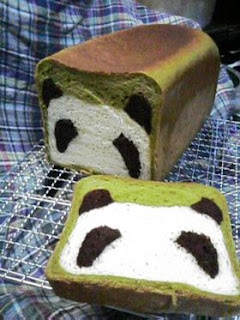
This was floating around on Pinterest a while ago and it got stuck in my brain, so while doing my laundry today and having to wait around for the washing machine to do its thing I thought I'd have a go at it. 

I did a bit of googling and found what has been credited as the original post from TaroTaro ( http://cookpad.com/recipe/349795 ) but it's in Japanese and I wasn't going to get anywhere with the auto-translation.  So another try found a blog called "Do What I Like" by Florence ( http://wlteef.blogspot.co.uk/2007_10_01_archive.html#!/2007/10/panda-bread.html ) who translated it into English otherwise I wouldn't have tried, thank-you Florence!  She also points out that October 15th is world bread day, which I think should be a holiday observed by all.

It was a lot easier to assemble than I thought, and a bit more fun, I almost wish it had taken longer to do but longer would have meant frustration so maybe it's better that it was fast.  I didn't have green tea powder so I used food colouring, I never thought something could be both lurid and pastel at the same time.

It split while baking where I had the wrinkle that I couldn't smooth out in the outer layer, I'm also thinking Taro has a special bread tin with a lid or something that lets her get a flat top on the loaf, but I'm still proud of effort. 

For a first attempt, I think it's sufficiently comical!

If you go to Taro's website she has a collection of pictures from over a hundred people who have tried and their sometimes hilarious results!

Sunday, 15 July 2012

Peanut Butter Cookies - Mom

FOOD FIT FOR A KING!  My Dad's opinion of peanut butter, and yes he's so emphatic in his opinion that it has to be written in capitals.

I'll be back in Canada in less than a month and my whole family will be able to stand in the same room at the same time, last time that happened was about eight years ago.  It's amazing how so few people can scatter so much geographically, there were a few years when it took 10 times zones to encompass all of us!  I'm looking forward to doing some baking with my nieces and nephews, although some of them are a bit young and will probably just help with licking spoons and eating the finished product.  My Dad is looking forward to the baking as well, my Mom is on a health kick that has her opposed to white flour and refined sugars to Dad's dismay, apparently Dad and I are going to survive on nothing but baked goods while I'm visiting!

So with my Dad on my mind, I thought I'd use the last of my peanut butter brought over from Canada to make some cookies.  Peanut butter cookies are a bit more labour intensive than chocolate chip or oatmeal cookies because the dough has to be rolled into balls then squished with a fork rather than just scooped with and dropped from a spoon.  But it was fun to eat them line by line along the fork groove. 

Peanut Butter Cookies
Pre-heat your oven to 350^F (175^C)
In a mixer cream together
1/2 cup butter
1/2 cup smooth peanut butter
1/2 cup brown sugar
1/2 cup granulated sugar

Add in and beat until fluffy
1 egg
1/2 tsp vanilla

Slowly blend in
1 cup plain flour
1/2 tsp baking soda
1/2 tsp salt

Roll the dough into small balls, about a tsp worth of dough, and place on a cookie sheet, give them room they will spread a lot, then flatten them with a fork.

Bake for 7 - 10 minutes and you will have soft chewy peanutty good cookies.


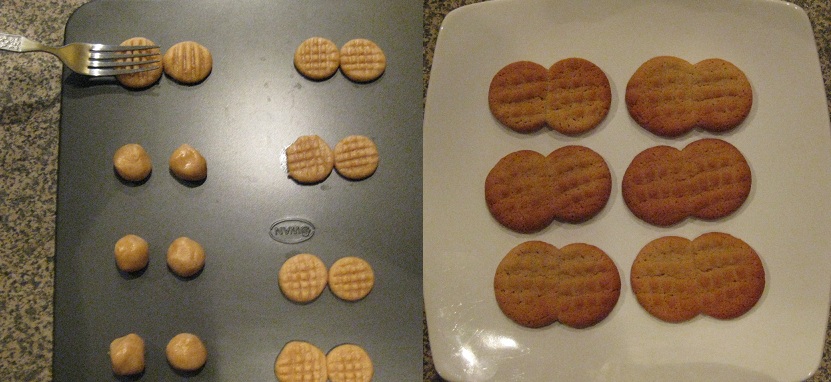
Okay, not traditional in our family at all, but I came across a picture of peanut butter cookies shaped like peanuts and I felt the need to try at least one tray of them.  Take the same amount of dough for a regular size cookie and divide in half, roll into two small balls and place near enough to each other on the tray that they will just touch when fork squished.  Make a double fork squish on each ball at 90 degree angles and make sure that one of them points straight towards the other ball of dough.  The two cookies spread together and form a 'peanut' shaped cookie!